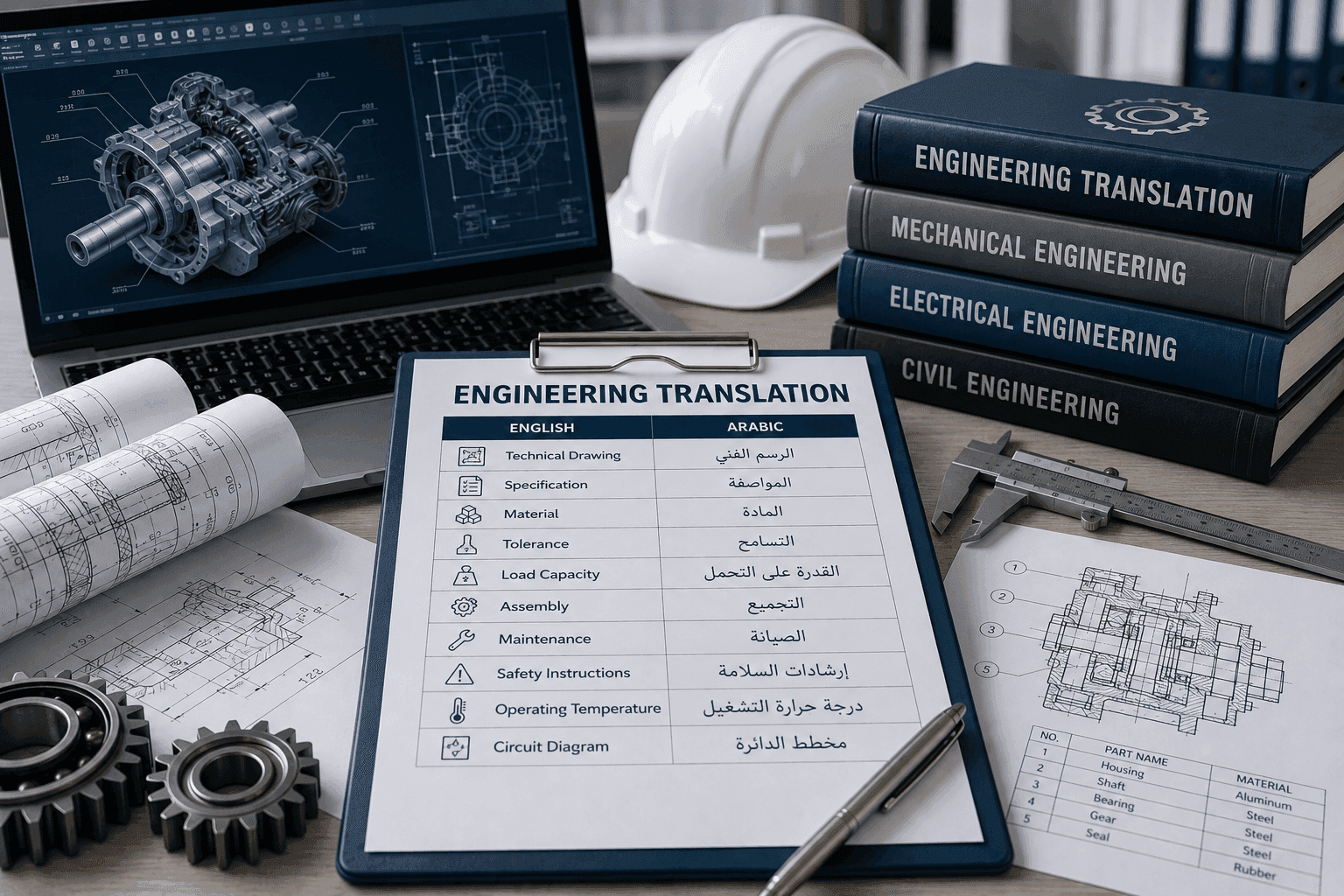
Engineering translation
Engineering Translation: Precision That Protects Your Project from Costly Errors
Discover how engineering translation protects projects from costly errors and ensures precise execution. Learn its role in successful global collaboration and safe operations.
 August 18, 2026
 Maged
Maged 0 Comments
 8 Minutes to read
In engineering projects, a single word can determine the success or failure of execution. Technical specifications, bills of quantities, and supervision reports are not merely texts to be read; they are precise instructions upon which tangible realities of concrete, steel, equipment, and operating systems are built.
As companies expand beyond their borders and increasingly rely on imported technologies and equipment, engineering translation has become a necessity that cannot be ignored. Any misunderstanding of a technical term or unit of measurement can lead to financial losses, delivery delays, or even safety risks.
What Is Engineering Translation?
Engineering translation involves transferring technical and engineering documents from one language to another while fully preserving their technical accuracy and specialized context.
It is not simply about replacing words with their equivalents. An engineering translator must have a real understanding of the project’s nature and be familiar with the terminology used in the relevant discipline, whether it is:
Civil Engineering
Architectural Engineering
Mechanical Engineering
Electrical Engineering
Telecommunications Engineering
Petroleum and Energy Engineering
Each field has precise terminology that does not tolerate literal translation or guesswork.
Why Is Engineering Translation Crucial to Project Success?
1. Execution Depends on Specifications
Drawings and technical specifications serve as the primary reference for engineers and contractors. If translated inaccurately, this may result in:
Using materials with incorrect specifications.
Executing engineering details improperly.
Rework with additional costs.
Delays in the project timeline.
In such cases, the issue is not merely linguistic—it becomes operational and financial.
2. International Collaboration Is Now a Reality
Many major projects today are executed through partnerships between companies from different countries. Professional engineering translation ensures clear communication between:
Design teams
Contractors
Suppliers
Consultants
It significantly reduces the risk of misunderstandings that could cost the project heavily.
3. Equipment Does Not Operate on Assumptions
When importing equipment or operating systems, manuals for operation and maintenance are often in foreign languages. Accurate translation ensures:
Proper operation.
Compliance with safety instructions.
Reduced malfunctions.
Extended equipment lifespan.
In industrial environments, there is no room for general or non-specialized translation.
Key Challenges in Engineering Translation
Terminology Accuracy:
Some engineering terms do not have direct literal equivalents, and their meanings may vary depending on context. This is where the translator’s technical background becomes essential.
Differences in Standards Between Countries:
Measurement systems, engineering codes, and specifications may differ from one country to another. Understanding the language alone is not enough; the translator must also understand the applicable system used in the project.
Legal Responsibility:
Engineering documents are often part of contracts or tenders. Any translation error may lead to contractual disputes or financial losses.
Why General Translation Is Not Enough in Engineering
General translation may work for marketing or literary texts, but it is not suitable for documents that rely on numbers, units, and precise terminology. A non-specialized translator may:
Confuse similar technical terms.
Translate a unit of measurement incorrectly.
Overlook an important technical implication within the context.
In engineering projects, there is no room for estimation or personal interpretation.
Standards of Professional Engineering Translation
For translation to be truly reliable, it must rely on:
Translators with engineering backgrounds or technical expertise.
The use of recognized and industry-approved terminology.
Careful review of numbers and measurement units.
Preservation of the original document’s formatting.
Final linguistic proofreading before delivery.
The Role of World Dictionary in Providing Accurate Engineering Translation
At World Dictionary for Translation, we understand that an engineering document is not just a text file—it may serve as the foundation for executing an entire project. Therefore, we rely on:
Specialized translators across various engineering fields.
Thorough technical review before delivery.
Full commitment to document confidentiality.
Deep understanding of project nature and requirements.
On-time delivery without compromising quality.
We treat every file as a real responsibility, knowing that even a minor mistake can result in significant real-world costs.
When Do You Need Specialized Engineering Translation?
You need this service when:
Participating in an international tender.
Importing equipment or technologies from abroad.
Executing a project in partnership with foreign entities.
Preparing a feasibility study for international investors.
Submitting technical reports to external authorities.
In such cases, relying on a specialized provider is not a luxury—it is a preventive step that protects your project.
Engineering translation is not merely a linguistic process; it is a fundamental element in the execution framework of any project that depends on technical precision. Understanding terminology, adhering to standards, and verifying figures are details that leave no room for error.
If you are looking for engineering translation that preserves the accuracy of your documents and supports the success of your project, World Dictionary for Translation offers the expertise and professionalism needed to ensure clear communication and safe execution.
Choosing the right translation partner may be the difference between a project that runs smoothly and one that faces avoidable challenges.