Medical Translation
Common Medical Translation Errors and Their Impact on Patient Safety
Discover the most common medical translation errors and how they can impact patient diagnosis and treatment. Learn why specialized medical translation is essential for accuracy and safety.
 July 23, 2026
 Maged
Maged 0 Comments
 8 Minutes to read
In the medical field, an error is not measured merely by an awkward sentence or an inaccurate term; it may be measured by a patient’s health or the course of an entire treatment. A medical term is not just a linguistic expression—it may carry a diagnosis, a treatment decision, or instructions that can lead to a patient’s improvement or deterioration. For this reason, medical translation is considered one of the most dangerous and precise fields of translation, because any mistake, even if it seems minor, can lead to serious health consequences that may be impossible to correct.
In this article, we review common medical translation errors and their impact on patient safety, explain the causes of these errors, how they affect medical practice in reality, and why relying on a specialized entity such as World Dictionary for Translation is a necessity rather than a luxury.
What Is Medical Translation?
Medical translation is the process of transferring medical and healthcare content from one language to another with complete scientific accuracy, while adhering to approved medical terminology and the correct clinical context. Medical translation includes various types of texts, such as:
Medical reports and patient records.
Laboratory and radiology results.
Drug leaflets and prescriptions.
Scientific research and studies.
Reports submitted to embassies and insurance companies.
What distinguishes medical translation from other types is that it does not allow for personal interpretation or guesswork, because any change in meaning may directly affect the medical decision.
Why Are Medical Translation Errors Dangerous?
The danger of medical translation errors lies not only in being linguistic mistakes, but in their real-life consequences, which may lead to:
Inaccurate diagnosis of a medical condition.
Prescribing inappropriate treatment or medication.
Misunderstanding the patient’s medical history.
Making incorrect treatment decisions.
Exposing the patient to serious health complications.
Therefore, errors in medical translation are a medical and ethical issue before being a linguistic one.
Common Medical Translation Errors
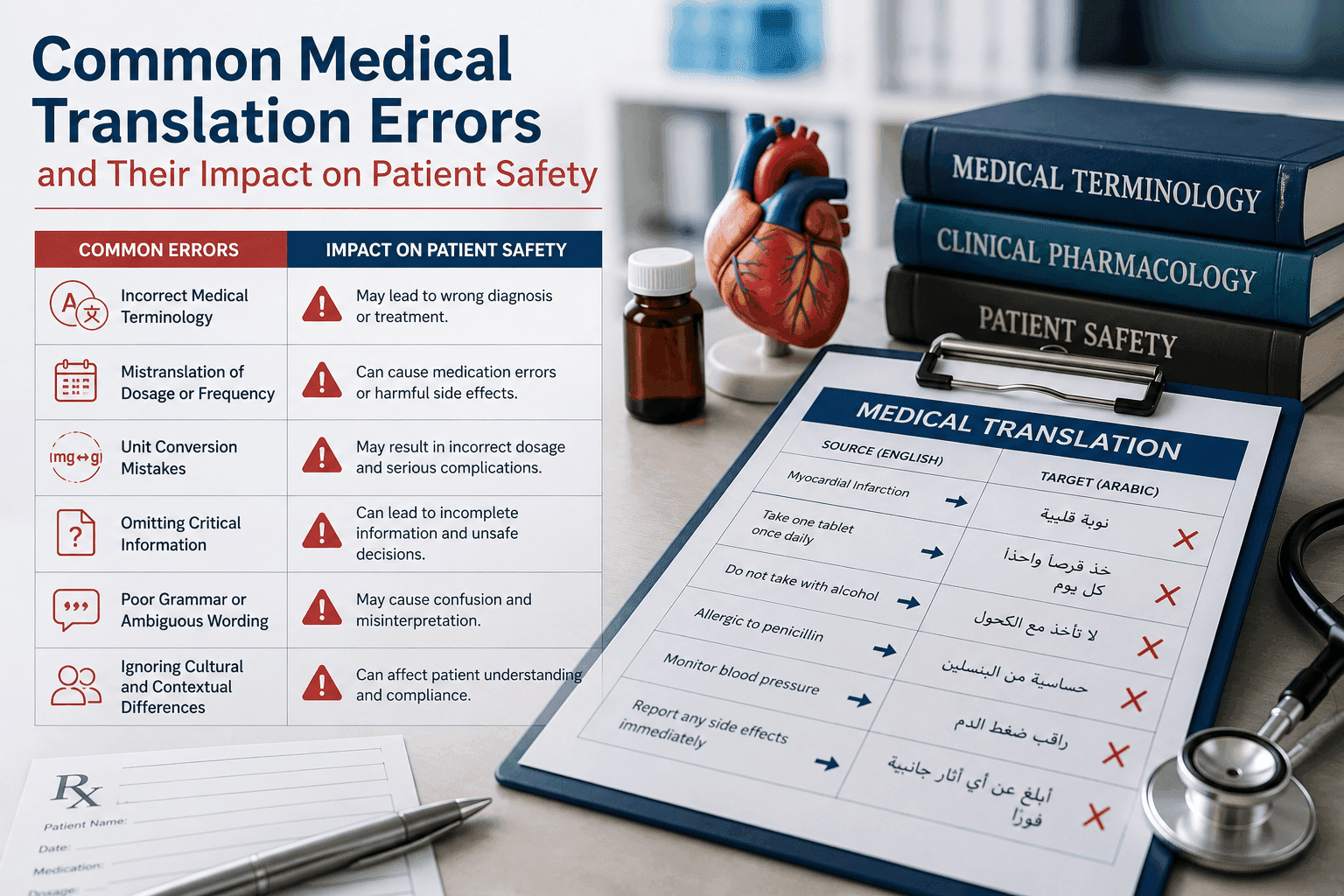
1. Literal Translation of Medical Terms
One of the most common errors is relying on literal translation without understanding the medical background of the term. Many medical terms cannot be properly understood except through the clinical context. Literal translation may convey the word, but fail to convey the meaning, which can completely distort the medical information.
2. Confusion Between Similar Terms
The medical field is full of terms that are similar in form or pronunciation but completely different in meaning and use. Confusing these terms—especially in diagnostic reports or prescriptions—may lead to serious treatment errors. This often happens when using a translator who is not specialized in the medical field.
3. Misunderstanding Medical Abbreviations
Medical abbreviations represent a real challenge, as a single abbreviation may have more than one meaning depending on the specialty or medical context. Translating these abbreviations without precise understanding may result in conveying completely incorrect information. Here, the practical experience of the medical translator and their ability to read the report like a physician—not just a translator—becomes essential.
4. Overlooking Precise Medical Details
Sometimes a number, a unit of measurement, or a marginal note is overlooked during translation. This is an extremely dangerous error, because the difference between two doses or between measurement units can be critical to patient safety. Accuracy in details is not optional in medical translation—it is an absolute necessity.
5. Relying on Machine Translation
Despite the significant development of machine translation tools, they are not suitable for handling medical content because they:
Do not accurately understand the medical context.
Make mistakes in specialized terminology.
Fail to distinguish subtle differences in meaning.
Bear no responsibility for errors.
Relying on them for medical documents may pose a direct risk to patient health.
6. Neglecting Medical and Linguistic Review
Failing to thoroughly review the translation may allow linguistic or scientific errors to slip through and affect the final meaning of the text. Professional medical translation always goes through linguistic proofreading and specialized medical review before approval.
The Impact of Medical Translation Errors on Patient Safety
Errors in medical translation may lead to:
Incorrect treatment decisions.
Delays in diagnosis.
Use of inappropriate medications or incorrect dosages.
Serious health complications
Loss of trust between the patient and the medical provider.
In some cases, the consequences of these errors may extend to serious legal liabilities for individuals or institutions.
How Can Medical Translation Errors Be Avoided?
Relying on Specialized Translators: A medical translator must have a scientific background and real knowledge of medical terminology, not just linguistic skills.
Choosing an Accredited Translation Office: Dealing with a trusted entity such as World Dictionary for Translation ensures that the translation goes through specialized review and verification stages.
Careful Review of the Translation: Medical and linguistic review is an essential step that cannot be skipped in any medical translation.
Avoiding Machine Translation: No automated tool should be relied upon for official or therapeutic medical documents.
The Role of World Dictionary for Translation in Reducing Medical Translation Errors
At World Dictionary for Translation, we fully understand that any error in medical translation may affect a patient’s health and safety. Therefore, we follow a strict workflow based on:
Specialized medical translators.
Use of internationally approved medical terminology.
Thorough review of all content before delivery.
Full commitment to the confidentiality of medical files.
Providing certified medical translation when required.
Our goal is not merely to translate text, but to transfer medical information safely, accurately, and responsibly.
When Do You Need Professional Medical Translation?
Accurate medical translation is essential in many cases, such as:
Traveling abroad for medical treatment.
Submitting medical reports to embassies.
Dealing with international hospitals and medical centers.
Health insurance procedures.
Legal cases related to medical conditions.
In all these cases, working with World Dictionary for Translation is a fundamental step to avoid errors and ensure accuracy.
Medical translation errors are not merely linguistic slips; they are mistakes that can directly affect human lives. Therefore, choosing a specialized and reliable translation provider is a decisive factor in protecting patients and ensuring the safety of medical content.
If you are looking for accurate, reliable, and certified medical translation, World Dictionary for Translation offers the expertise and professionalism that guarantee the highest levels of accuracy and responsibility.