Certificate Translation
Certified Schengen Visa Translation
Learn which documents may require certified Schengen visa translation, along with key requirements and common mistakes to avoid when preparing your application.
 September 15, 2026
 Maged
Maged 0 Comments
 8 Minutes to read
The outcome of your application to travel to Europe may depend on small details within your documents, such as inconsistent name spellings, an incorrect date, or submitting a document in a language that the embassy does not accept. For this reason, certified Schengen visa translation is an essential step when preparing your visa application, particularly when the original documents are issued in Arabic and the embassy requires them in English or the official language of your destination country.
Certified translation involves more than converting words from one language into another. It requires every piece of information to be transferred accurately, the legal meaning of each document to be preserved, and all names, numbers, and dates to match the original documents. The translation should also be issued by a specialised provider capable of preparing officially formatted documents suitable for submission to embassies and visa application centres.
What Is Certified Schengen Visa Translation?
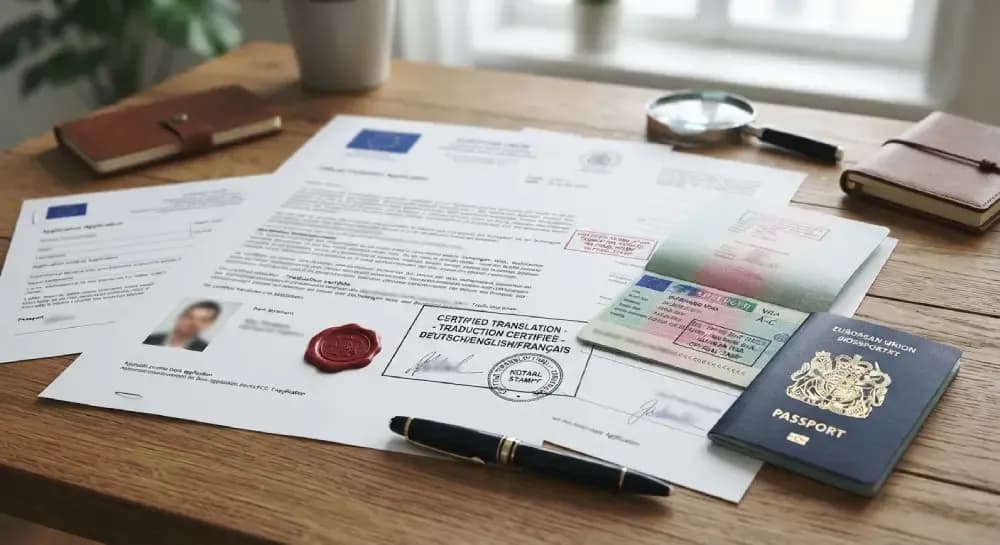
Certified Schengen visa translation is the official translation of documents submitted as part of a Schengen visa application. It usually includes the translation provider’s details, an official stamp, and a declaration confirming that the translation is accurate and corresponds to the original document. These elements help the embassy or visa application centre verify and understand the contents of the submitted documents.
The required translation language may vary depending on the country processing the application, the visa category, and the purpose of travel. Some embassies accept documents translated into English, while others require translation into their official language.
Applicants should therefore review the requirements published by the relevant embassy or visa centre before beginning the translation process. A certified translation does not automatically guarantee visa approval, but it helps ensure that the application is clear and meets the relevant language requirements.
Which Documents May Require Certified Translation?
The required documents vary depending on whether you are applying for a tourist, study, work, family visit, or medical Schengen visa. Documents that may require certified translation include:
- Passport and pages containing personal information or previous visas.
- Birth certificate.
- Marriage certificate or divorce certificate.
- Family register and other documents related to marital status.
- Bank statements and proof of income.
- Salary certificate and employer letter.
- Commercial registration and company ownership documents for business owners.
- Educational certificates and academic qualifications.
- Invitation letter or documents belonging to the host.
- Medical reports when travelling for treatment.
- Parental consent documents for minors, where applicable.
- Property documents or supporting evidence demonstrating ties to the applicant’s country of residence.
You can use our Saudi Passport Translation service to ensure that the name, passport number, issue date, and expiry date are translated accurately. Specialised services are also available for Birth Certificate Translation and Marriage Certificate Translation, using clear and formal wording.
Why Is Accuracy Important in Schengen Visa Document Translation?
Embassies assess a visa application as an interconnected collection of information. Any inconsistency between the submitted documents may lead to additional questions or delays in processing the application.
Common issues include spelling a name differently from how it appears in the passport, reversing the day and month in dates, or translating a job title inaccurately.
Professional Certified Translation for Official Documents ensures that information and terminology are communicated clearly. It also involves reviewing the translated document and comparing it with the original before delivery.
This level of accuracy is particularly important when translating legal and financial documents, as an error in a number, date, or legal capacity could change the meaning of the document.
Requirements for Translation Accepted in a Schengen Visa Application
There is no single translation rule that applies to every Schengen embassy. However, several essential standards should be considered when preparing your translated documents:
- Translate the document into the language specified by the embassy.
- Ensure that names are written exactly as they appear in the passport.
- Translate all visible stamps, notes, and information.
- Do not omit any part of the document, even if it appears irrelevant.
- Clearly indicate any illegible text or unclear stamps.
- Include the translation provider’s details and official certification stamp.
- Preserve the order of information to make comparison with the original easier.
- Provide a clear and recent copy of the document when requested.
Some authorities may require an additional procedure, such as legalisation, attestation, or submission of the original document or a copy.
It is therefore important to distinguish between certified translation and document attestation. Translation transfers the content of a document into another language and confirms its accuracy, while attestation is a separate procedure that may be required to verify the authenticity of a signature or stamp.
Steps to Obtain Certified Schengen Visa Translation
The process begins by submitting clear and complete copies of your documents. You should also specify the country to which you are applying, the required translation language, and the expected date of your visa appointment.
The documents are then reviewed to determine the number of pages, cost, and expected turnaround time.
A professional translator transfers the information and terminology according to the nature of each document. The translation then undergoes linguistic review, during which names, dates, and numbers are carefully compared with the original.
In the final stage, the certified copy is prepared with the required stamp and provider details. It is then delivered using the agreed method.
It is advisable not to postpone translation until the final days before your submission appointment, especially if the application contains numerous documents or includes financial and legal records that require careful review.
Mistakes to Avoid When Translating a Schengen Visa Application
One of the most common mistakes is relying on machine translation or an unofficial translation. Applicants may also submit unclear images of their documents, use an outdated translation after the original document has been updated, or fail to maintain consistent name spellings across the passport and supporting documents.
You should also avoid assuming that every Schengen embassy accepts the same language or requests identical documents.
Requirements may differ according to the destination country, visa category, applicant’s nationality, and place of application. The instructions issued by the relevant embassy or visa application centre should always be treated as the primary reference.
Do All Schengen Visa Documents Need to Be Translated?
Not necessarily. This depends on the original language of the documents and the requirements of the embassy processing the application. Review the official document checklist to identify which documents require translation.
Which Language Is Required for Schengen Visa Documents?
The required language may be English or the official language of the destination country. Requirements vary between embassies, so applicants should confirm the accepted language before arranging the translation.
Is Certified Translation Sufficient Without Attestation?
This depends on the type of document and the embassy’s instructions. Some documents require certified translation only, while others may require additional attestation or legalisation.
How Long Does Schengen Visa Document Translation Take?
The turnaround time depends on the number of documents, their languages, their complexity, and the clarity of the submitted copies. Simple documents can usually be completed more quickly, while large or specialised files may require additional review time.
Does Certified Translation Guarantee Visa Approval?
No. Visa decisions are made by the embassy following a complete assessment of the application. However, accurate translation helps applicants meet language requirements and avoid errors that could delay processing or lead to requests for additional documents.
Can Academic Certificates Be Translated for a Study Visa?
Yes. You can request Academic Certificate Translation for study visa applications or academic admission procedures, depending on the requirements of the relevant institution.
Request Certified Translation for Your Schengen Visa Documents
If you are preparing to travel, World Dictionary Certified Translation provides professional certified Schengen visa translation, with careful review of names, dates, and other important details while maintaining complete document confidentiality.
Get certified Schengen visa translation that helps you submit a clear, accurate, and well-organised application. Contact our team to send your documents and receive a quotation and estimated delivery date.